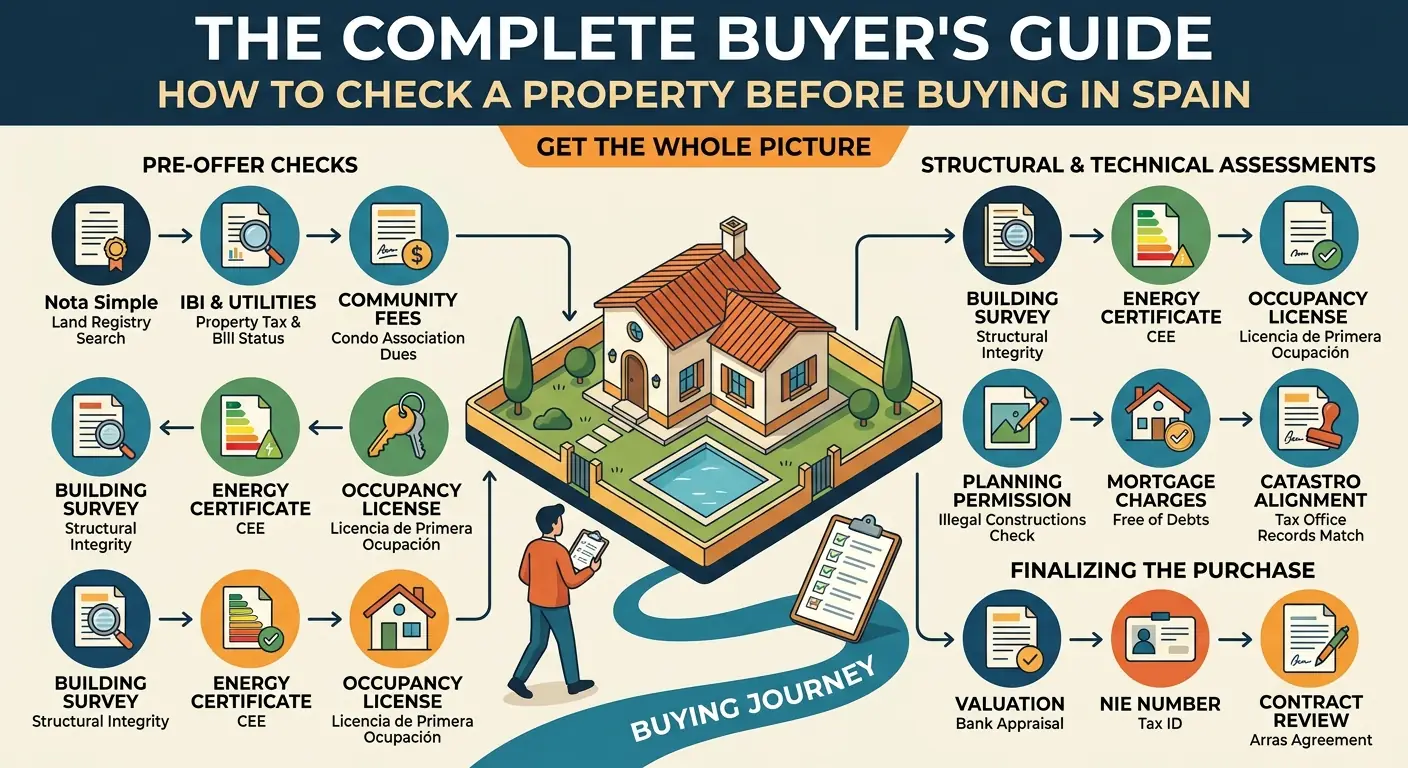
Buying a property in Spain can look fairly simple: you find a place, agree on a price, check the paperwork, and sign. But there's a big gap between "I like this house" and "I actually understand what I'm buying."
A property has several different "stories" running at once: its cadastral description, its registered rights, its municipal records, its Comunidad de Propietarios history, its taxes and running costs — and one more thing that no register can show you: its real physical condition.
That's why it's worth splitting due diligence into layers. The good news is that a meaningful share of it a buyer can do themselves — you don't need to be a lawyer or an engineer, you need to know what to check and where self-checking reaches its limit.
This article is a complete overview of the process. Every topic below has its own dedicated deep-dive article — linked as we go, with the full list under "Read More" at the end.
Quick Checklist: What to Check Before You Buy
Where to start:
- Identify the property — address, referencia catastral, key documents.
- Check the Catastro — compare cadastral data against what the seller shows you and what physically exists.
- Check the Registro de la Propiedad — registered rights, owners, and charges.
- Check the Ayuntamiento — if there's any doubt about an extension, a pool, a basement, or an extra floor.
- Check the Comunidad — for an apartment, the condition of the whole building matters, not just the unit.
- Check taxes and running costs — IBI, Comunidad fees, derramas, utilities.
- Check the engineering systems — water, electricity, gas, heating, pool.
- Check the physical condition — damp, leaks, ventilation, visible defects.
- Bring in specialised expertise where needed.
1. Catastro: What You Can Find Out About a Property
One of the first sources to check is the Sede Electrónica del Catastro. There you can get the referencia catastral, the floor area, the year of construction, the building's characteristics, the plot, and cadastral mapping.
Important to understand up front: the year of construction shown in the Catastro doesn't prove every element that exists today was built or altered legally. A house might have been built in 1980, with a pool, an extension, or an extra floor added later — without the paperwork to match.
📌 More detail: How to Find a Property's Year of Construction in Spain and How to Get Cadastral Information on a Property in Spain
2. Catastro and Registro de la Propiedad Are Not the Same Thing
This is one of the most important things for a foreign buyer to understand: these are different systems, answering different questions. The Catastro describes the property's physical characteristics. The Registro records the registered rights over it.
So you can't conclude "I checked the Catastro, so everything's fine," or "I got a Nota Simple, so the house must be technically sound."
📌 Full comparison: Catastro vs Registro de la Propiedad
3. Nota Simple: What to Check in the Registro de la Propiedad
The Colegio de Registradores lets you request a Nota Simple — a document showing the registered owners, the nature of their rights, and any restrictions (pleno dominio, hipoteca, usufructo, cargas, and others).
An important nuance: a Nota Simple is informational, not a document with full evidentiary force (a certificación). The registered situation can also change after it's issued — so for the actual transaction, what matters is how current the information is at the time.
📌 More detail: How to Get a Nota Simple in Spain and What Does a Nota Simple Actually Show?
4. Compare the Catastro, the Registro, the Escritura and the Real Property
This is where the real checking starts. Compare the floor area and description of the property across the Catastro, the Registro, and the Escritura — against what you actually see physically: the pool, the garage, the basement, the plot.
If everything matches, good. If it doesn't, that's not necessarily a problem — but it needs an explanation.
The key principle: a discrepancy between sources isn't always a problem. An unexplained discrepancy is already a reason to look further.
5. The Ayuntamiento and Urbanismo
Some questions can only be answered by the municipality: is an extension legal, can a basement be counted as habitable space, is there a permit for the pool, when did the extra floor appear?
The specific procedures depend on the municipality — checking a property in Alicante is organised differently than in Madrid or Málaga.
For houses, the list of questions is usually much wider: extensions, extra floors, basements, garages, pools, summer kitchens, enclosed terraces, and changes of use for existing rooms. A room physically existing doesn't mean its legal status matches how the seller is using it.
📌 We cover this in full in a dedicated guide to checking whether an extension is legally authorised, coming soon in this series.
6. Comunidad de Propietarios
Buying an apartment means buying a share of the building — so the condition of the Comunidad matters: the size of the cuota (the regular monthly or quarterly fee), any debt, derramas (one-off special assessments for major works) already approved or planned, and the state of the roof, façade, lift, and pool.
For context, the average ordinary cuota for an apartment in Spain runs around €100–110 a month (roughly €1,260 a year), though buildings with a lift, pool, or concierge commonly run to €200–300 a month — it depends heavily on the building's services and number of units.
The minutes of Juntas de Propietarios (actas) are especially useful — they can reveal problems invisible during a normal viewing: façade repairs, roof leaks, riser replacements, ongoing legal disputes.
Why this matters to a buyer: under the Ley de Propiedad Horizontal (Ley 49/1960, Article 9.1.e), the property itself is liable for the previous owner's unpaid Comunidad debt, within the current calendar year and the three preceding ones — a propter rem obligation attached to the property rather than a personal debt of the new owner. At the point of transfer, the seller must normally provide a certificate confirming their account status with the Comunidad, unless the buyer has expressly waived that requirement.
This is general information, not legal advice — the specific terms of any transaction should be confirmed with a lawyer.
📌 We cover this in full in a dedicated guide to checking Comunidad debts, coming soon in this series.
7. Derrama: Don't Just Look at the Total
If the Comunidad has an active derrama, it's worth establishing not just the amount, but what's actually being repaired, whether it's been formally approved, what the total project cost is, when payments fall due, and how much remains after your purchase.
A beautifully renovated apartment can sit inside a building that's months away from an expensive roof or façade repair.
📌 We cover this in full in a dedicated guide to what a derrama actually is, coming soon in this series.
8. IBI and Other Taxes
IBI (Impuesto sobre Bienes Inmuebles) is a municipal property tax based on data set out under the Ley Reguladora de las Haciendas Locales. Rates for urban properties typically run 0.4%–1.1% of the cadastral value (rural properties are usually lower, around 0.3%–0.9%) — and it's worth remembering that cadastral value itself is normally 30–60% below market price, so the tax bill is smaller than the rate alone suggests. The exact rate, and any arrears, need to be checked through the property's specific municipality, since each Ayuntamiento sets its own coefficient within those national bands.
For an apartment, Comunidad fees are added on top of IBI (see section 6 for typical ranges). For a house, running costs can also include the pool, the garden, water, electricity, gas, insurance, an alarm system, and equipment maintenance — these vary too widely by property to quote a single "average," so it's worth asking the seller for a full year of actual bills rather than relying on a rule of thumb.
9. Water, Electricity and Gas
Water. Ask for recent bills, check the meter, test the taps, drainage, hot water and pressure. A visual check doesn't rule out a hidden leak — if you suspect one, that calls for instrument-based testing.
Electricity. You can look at the distribution board, the breakers, the diferencial, the condition of the wiring and sockets yourself, and request documentation (such as the CIE). A full assessment of earthing, protection and load is a job for a qualified electrician.
Gas. It's worth separately checking the type of gas supply, the boiler or water heater, ventilation, exhaust routing, and whether appropriate safety sensors are in place.
10. Energy Efficiency
The Certificado de Eficiencia Energética is useful for gauging energy performance, but it isn't a technical inspection — it doesn't answer questions about damp, leaks, window quality, or hidden defects. It's one document among several, not a substitute for an inspection.
It's also a legal requirement, not an optional extra: sellers have been obliged to provide a valid energy certificate before advertising or completing a sale since 1 June 2013 (Real Decreto 235/2013), with the certification procedure itself updated by Real Decreto 390/2021 (in force since 3 June 2021). The certificate is valid for 10 years, and its energy rating must appear in any listing or advertisement for the property.
11. What Documents Can't Normally Tell You
Documents tell you what's registered — not the condition it's actually in today: hidden damp, signs of leaks, thermal anomalies, ventilation performance, the state of pool pump equipment, or signs of trouble with retaining walls. For that, you need to look at the property itself.
12. What Is a Technical Property Inspection?
A technical property inspection is a practical way to get an independent opinion on a property's physical condition before you buy. It isn't necessarily a full structural survey, and it doesn't involve opening up construction elements.
The main question is usually simpler: are there signs here of problems I should know about before signing?
Depending on the property, an inspector may use a moisture meter, a thermal imaging camera, instruments for measuring air humidity and water pressure, and other diagnostic tools — checking walls, ceilings, floors, windows, terraces, the roof, accessible structures, water, electricity, gas, ventilation, heating, the pool, and the plot.
The goal of an inspection isn't to find absolutely everything that's ever happened to a house — it's to identify existing warning signs and determine whether they need further investigation.
An inspection is not a structural survey. A technical inspection answers a broad, practical question about a property's condition. A specialised engineering survey answers a narrow question about one specific structural element. For example, if an inspection finds an unusual crack, the inspector notes and assesses it — but if there are signs of serious structural movement, the next step is an assessment by a structural engineer.
For a full breakdown of exactly what this kind of inspection covers and how it compares to a formal building survey, see our guides to the 7 Key Risks Property Buyers Shouldn't Ignore, the DIY Inspection Checklist, and The Small Defects Buyers Miss on a Viewing.
13. The Swimming Pool
A pool is its own risk area: pump equipment, waterproofing, filtration, and electrical safety near water all need separate attention, and pool permitting is a separate question for the Ayuntamiento (see section 5).
📌 We cover this in full in a dedicated guide to checking a swimming pool before buying, coming soon in this series.
14. What Can a Buyer Check Themselves?
This isn't a list of mandatory steps — it's a map of what's possible. Not every property needs the same depth of checking.
| Check | Yourself | Online | Specialist |
|---|---|---|---|
| Year of construction | Yes | Yes | — |
| Referencia catastral | Yes | Yes | — |
| Cadastral data and map | Yes | Yes | — |
| Nota Simple | Partially | Yes | If needed |
| Owner and rights | Partially | Yes | Lawyer |
| Cargas (charges) | No | Yes | Lawyer |
| Urbanismo status | Partially | Partially | If needed |
| Comunidad / derramas | Yes | No | — |
| IBI | Yes | Partially | — |
| Water / electricity / gas | Partially | No | If needed |
| Damp / hidden leaks | Limited | No | Yes |
| Thermal bridges | No | No | Yes |
| Pool | Partially | No | Yes |
| Structural elements | Limited | No | Engineer |
15. What Level of Checking Do You Actually Need?
- A new apartment in a modern building — focus on the paperwork, the Comunidad, and the actual condition of the unit.
- An apartment in an older building — add damp, ventilation, windows, electrics, plumbing, the building's roof and façade, and future derramas.
- An older house — add the roof, walls, basement, terraces, pool, plot, retaining walls, drainage, extensions, and urbanismo status.
- A house on a slope — pay particular attention to retaining walls, drainage, cracking, ground movement, and the condition of external structures.
There's no universal checklist that fits every property in Spain.
16. How Much Does a Property Inspection Cost?
Cost depends on floor area, number of rooms, number of floors, the plot, the pool, the number of engineering systems, additional structures, and the scope of measurements involved. An apartment, a small townhouse, and a villa with land are entirely different scopes of work. The right approach is to first establish exactly what needs checking, then choose the scope of service accordingly.
📌 For a full cost breakdown, see How Much Does a Home Inspection Cost in Spain?
17. The Golden Rule: Don't Pay for What You Can Check Yourself
The referencia catastral, the cadastral map, the Nota Simple, IBI, the Comunidad fee, meeting minutes, comparing floor areas across documents — all of this is worth doing yourself.
But questions like "why is there elevated humidity in this corner," "is there a thermal bridge here," or "is the pool system actually working properly" need more than documents — they need inspection, measurement, and experience.
That said, a fair amount of the physical side is also worth checking yourself before paying for a professional visit: running every tap, opening the fuse box, testing windows and doors, looking for obvious cracks or damp patches. Our DIY Inspection Checklist walks through exactly what a buyer can reasonably check room by room, and which red flags mean it's time to call in a pre-purchase technical inspection instead.
18. What to Do If You Find a Problem
Not every problem means walking away from the purchase. Elevated humidity could be down to ventilation, a leak, or a thermal bridge — three completely different situations.
A good first inspection shouldn't just state "there's a problem" — it should help you understand how serious it is and whether it needs further investigation. Where necessary, the next step is a specialist: an engineer, an electrician, a waterproofing specialist, or a pool specialist.
19. Official Sources
- Catastro — Sede Electrónica del Catastro — cadastral information and mapping.
- Registro de la Propiedad — Colegio de Registradores — Nota Simple and registration information.
- BOE — Boletín Oficial del Estado — legislation, including the Ley de Propiedad Horizontal and local tax law.
- Ayuntamiento — for urbanismo, local taxes, and municipal procedures; use the website of the specific municipality where the property is located — there's no single service covering all of Spain, so no single link applies here.
20. The Complete Pre-Purchase Checking Map
- Documents: Catastro → Registro → Escritura → Ayuntamiento
- Financial side: IBI → Comunidad → Derramas → utilities
- Engineering systems: Water → electricity → gas → heating → air conditioning
- Physical condition: Damp → leaks → ventilation → windows → roof → terraces → structure → pool → plot
- Further investigation: only if the initial check flags a problem, or the property has unusual complexity
Frequently Asked Questions
How do I check a property before buying in Spain?
Work through it in layers: start with the documents (Catastro, Registro, Escritura, Ayuntamiento), then the financial side (IBI, Comunidad, derramas), then the engineering systems, and finally the physical condition of the property itself. The full order is set out at the top of this guide.
How do I find a property's year of construction in Spain?
In most cases, the year of construction is available through the cadastral information on the Sede Electrónica del Catastro. But that's a starting point, not a guarantee that every current element of the property (extensions, a pool, an extra floor) was properly registered. → Read more
How do I get cadastral information on a property?
Through the official Sede Electrónica del Catastro portal, you can get the referencia catastral, floor area, year of construction, and cadastral mapping by address or cadastral number. → Read more
How do I get a Nota Simple?
A Nota Simple is requested through the Colegio de Registradores portal. It contains information on the registered rights, owners, and charges against a property. → Read more
What does a Nota Simple actually show?
A Nota Simple shows registered rights (pleno dominio, hipoteca, usufructo, and others), the owners, and restrictions (cargas). It doesn't reflect the property's technical condition, and it's informational rather than a certifying document. → Read more
What's the difference between Catastro and Registro de la Propiedad?
The Catastro describes a property's physical and cadastral characteristics. The Registro de la Propiedad records its registered rights. These are different systems answering different questions, and checking one doesn't replace checking the other. → Read more
How do I check whether there's debt owed to the Comunidad?
Ask the seller for a certificate of account status with the Comunidad, and request the minutes of recent Juntas de Propietarios — those also cover any planned repairs and derramas. → We cover this in full in a dedicated guide, coming soon in this series.
What is a derrama when buying an apartment in Spain?
A derrama is a one-off contribution from owners toward major building works (roof, façade, lift repairs, and so on), separate from the regular cuota. Before buying, it's worth knowing not just the total, but the decision status, the payment schedule, and what remains after the sale. → We cover this in full in a dedicated guide, coming soon in this series.
How do I check whether an extension is legal?
The permit status of extensions, extra floors, and converted rooms is checked through the relevant Ayuntamiento's municipal urbanismo documentation — the exact procedure depends on the specific municipality. → We cover this in full in a dedicated guide, coming soon in this series.
How do I check a pool before buying a house?
Checking a pool covers the condition of the pump equipment, waterproofing, filtration, electrical safety, and whether the pool itself has the right permits on file with the Ayuntamiento. → We cover this in full in a dedicated guide, coming soon in this series.
The Bottom Line
Buying a property in Spain doesn't require becoming a lawyer, an engineer, and an urbanismo specialist all at once. But it does require understanding what you can check yourself, and what you can't.
The Catastro doesn't replace the Registro. The Registro doesn't replace the Ayuntamiento. A Nota Simple says nothing about a building's technical condition. A building's ITE doesn't replace checking a specific apartment. An energy certificate won't reveal hidden damp. And a beautiful renovation tells you nothing about what's behind the finish.
There's no single document that confirms "everything about this property is fine." Instead, work through several layers of checking: first, what you can do yourself; then the documents and municipal information; then the Comunidad's condition and future costs; and finally, the physical condition of the property itself.
If the documents and preliminary checks raise no questions, additional technical checking can be minimal. If the property is old, complex, has a pool, land, extensions, or sits on a slope, its physical condition deserves considerably more attention.
Spending a little time and money before you buy is almost always easier than dealing with a problem after the property is already yours.
Before you buy — know what you're buying. If you still have doubts about a specific property after reading this, get in touch — we'll help you work out what level of checking your case actually needs, and carry out the inspection on site.
Read More In This Series
- How to Find a Property's Year of Construction in Spain
- How to Get Cadastral Information on a Property in Spain
- How to Get a Nota Simple in Spain
- What Does a Nota Simple Actually Show?
- Catastro vs Registro de la Propiedad
More guides in this series — covering Comunidad debts, derramas, extension legality, and pool checks — are coming soon.