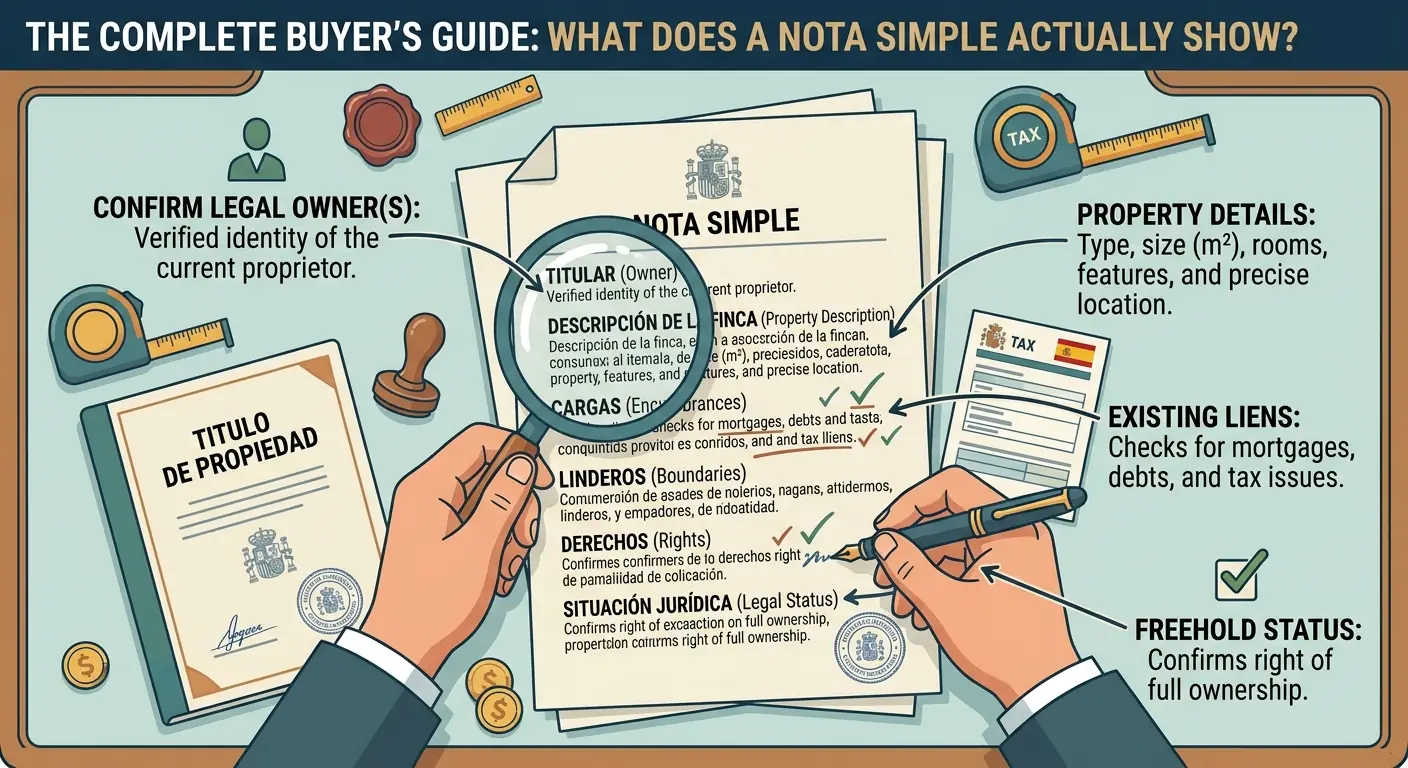
If you already know how to order a Nota Simple (see How to Get a Nota Simple in Spain), the next logical question is what the document actually tells you, and how to read it.
The Structure of a Nota Simple
A Nota Simple is normally made up of a few distinct blocks.
1. Property description (descripción de la finca)
- address and location;
- floor area;
- boundaries (linderos);
- referencia catastral, if included;
- for apartments, sometimes the share of the building's common elements (cuota de participación).
2. Ownership (titularidad)
Who's registered as the owner, on what basis (purchase, inheritance, gift), and what share each owner holds if there's more than one.
3. Rights (derechos)
Registered rights over the property:
- pleno dominio — full ownership;
- usufructo — the right to use the property without the right to dispose of it (common in inheritance situations);
- nuda propiedad — ownership without the right of use, the counterpart to usufructo.
4. Charges (cargas)
One of the most important sections for a buyer:
- hipoteca — a mortgage registered in favour of a bank;
- embargo — a seizure imposed through a court or administrative process;
- servidumbre — an easement (for example, a right of way in favour of a neighbouring property);
- other restrictions and annotations.
What a Nota Simple Does NOT Show
This part matters just as much as what it does show.
A Nota Simple contains no information about:
- the property's physical or technical condition — damp, wiring, roof condition;
- debts owed to the Comunidad de Propietarios (that's a separate certificate, requested from the building's administrator);
- IBI (property tax) debt (a municipal tax, checked separately through the Ayuntamiento);
- whether extensions, extra floors or converted rooms are legally authorised — that's a matter of municipal urbanística documentation, not the property registry.
A mistake worth avoiding: treating a "clean" Nota Simple as confirmation that everything about the property is fine. It only confirms what relates to registered rights — nothing more, nothing less.
📌 For Comunidad debts specifically, see our dedicated guide to checking Comunidad debts, coming soon in this series.
How Current Is the Information in a Nota Simple?
The document reflects the registered situation at the moment it's issued. After that, the situation can theoretically change — for example, a new embargo could be registered. So in practice:
- for a preliminary check of a property, a standard Nota Simple is enough;
- closer to the actual transaction, it's sensible to request a more recent one, to confirm nothing has changed;
- the signing itself (the Escritura, before a notary) is normally accompanied by an additional check of the registered status immediately before signing — this is standard practice for notaries and lawyers.
Reading a Nota Simple When Something's Unclear
Wording in the cargas section can be non-obvious — for example, an old embargo might already have been lifted, but the record of that requires reading carefully. If anything in the document raises a question, it's more reliable to ask the lawyer handling the transaction than to guess.
Frequently Asked Questions
Does a Nota Simple tell me if the seller has unpaid community fees?
No. Comunidad debts are a separate matter, checked through a certificate from the building's administrator, not through the Nota Simple.
What's the difference between a Nota Simple and a certificación registral?
A Nota Simple is informational and sufficient for most pre-purchase checks. A certificación registral carries full evidentiary force and can be requested separately when that level of certainty is needed — for example, for certain formal or legal purposes.
If the Nota Simple is clean, does that mean the property has no problems?
No — it only confirms there are no registered charges or ownership issues. It says nothing about physical condition, urbanismo status, or Comunidad debts.
This article is part of our complete guide, How to Check a Property Before Buying in Spain. See also How to Get a Nota Simple in Spain and Catastro vs Registro de la Propiedad.