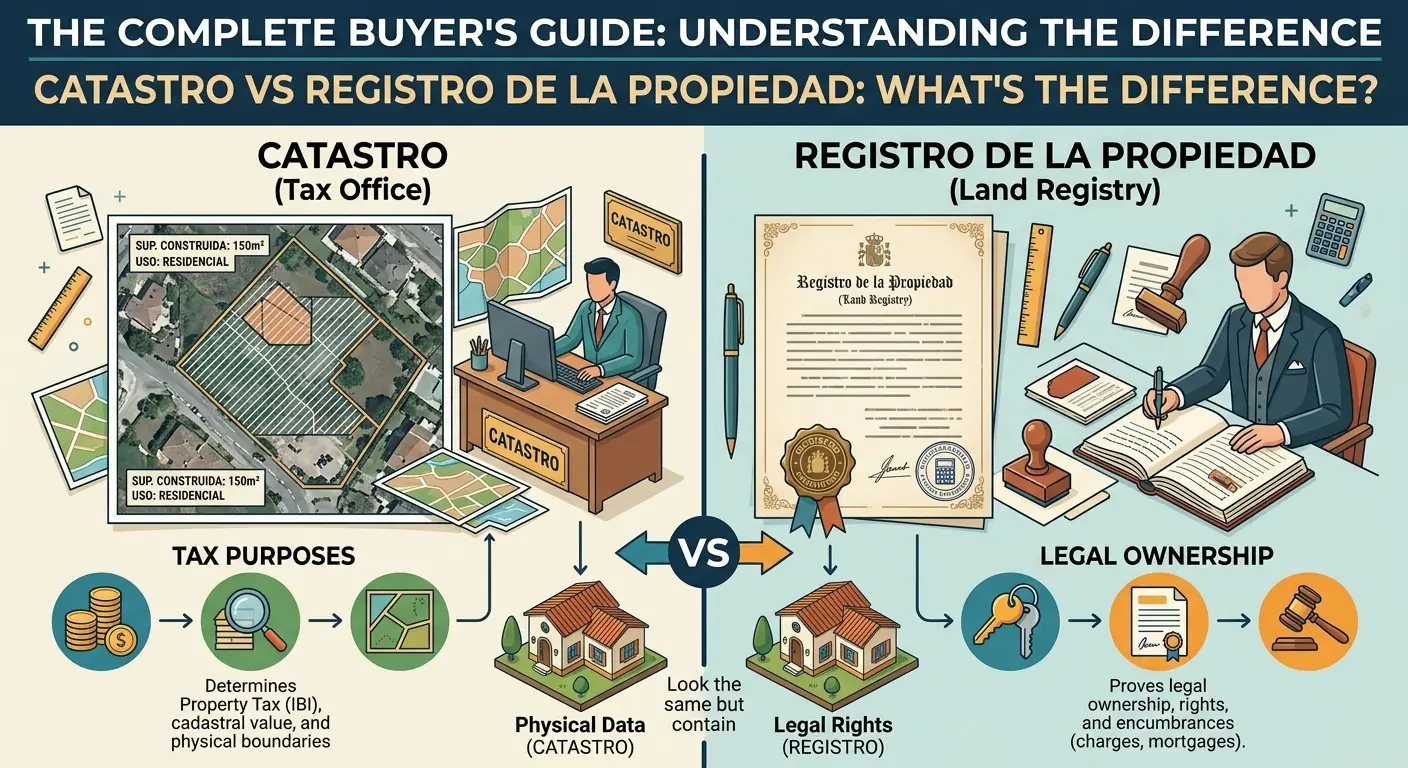
This is probably the single most common point of confusion for foreign buyers in Spain: treating the Catastro and the Registro de la Propiedad as if they were the same "official register." They are not. They're two independent systems, run by different bodies, that answer two different questions.
Catastro: What It Is and What It's For
The Catastro is an administrative record that describes a property's physical characteristics:
- where it's located;
- how large it is;
- its year of construction;
- its official use;
- what the plot and any buildings on it look like, via cadastral mapping.
The Catastro exists primarily for tax and statistical purposes — the IBI (property tax) calculation is based on its data.
📌 How to actually pull this data: How to Get Cadastral Information on a Property in Spain
Registro de la Propiedad: What It Is and What It's For
The Registro de la Propiedad (Land Registry) records registered rights to a property. It doesn't answer "what is this property," it answers "who owns it, and what rights or restrictions are registered against it":
- who the owner is;
- whether there's a mortgage;
- whether there's an embargo or court restriction;
- whether there are easements or other charges.
Registro information is requested through a Nota Simple.
📌 More detail: How to Get a Nota Simple in Spain and What Does a Nota Simple Actually Show?
The Key Differences, at a Glance
| Catastro | Registro de la Propiedad | |
|---|---|---|
| What it describes | The property's physical characteristics | Registered rights to the property |
| Main purpose | Tax and administrative | Legal (ownership rights) |
| Key document | Cadastral certificate | Nota Simple |
| Shows the owner | Not reliably, and not for all purposes | Yes — this is its core function |
| Shows a mortgage or embargo | No | Yes |
| Shows year of construction | Yes | Not always |
| Shows technical/physical condition | No | No |
Why These Two Checks Are Not Interchangeable
Catastro and Registro data are not required to match 100% — they're separate systems, updated independently, and not always automatically synchronised. For example:
- a property's floor area in the Catastro can differ from the area shown in the Registro, for historical reasons or because one system wasn't updated in time;
- an extension might physically exist and even show up partially in the Catastro, without being properly registered in the Registro — or the reverse.
The practical takeaway: checking the Catastro doesn't replace checking the Registro, and vice versa. You need both — and ideally, you cross-check them against each other and against the property itself.
📌 What to do if the data doesn't match the actual building: we cover this in a dedicated guide to checking whether an extension is legally authorised, coming soon in this series.
A Common Buyer Mistake
"I got the Nota Simple, so the house must be technically sound" is just as wrong as "I checked the Catastro, so the property must be legally fine." Neither document answers anything about the property's physical condition — damp, wiring, roof condition. That requires a separate, third layer of checking: a visual inspection and, where needed, a professional technical inspection.
Frequently Asked Questions
Do I need to check both the Catastro and the Registro?
Yes. They cover different things — physical description versus legal ownership and charges — and neither one substitutes for the other.
If the Catastro and Registro don't match, is that a problem?
Not automatically. A mismatch is common and often has a legitimate explanation (unsynchronised updates, historical discrepancies). An unexplained mismatch is what's worth investigating further.
Does either document tell me about the property's physical condition?
No. Neither the Catastro nor the Registro/Nota Simple says anything about damp, wiring, plumbing, or structural condition. That requires a visual inspection, and where needed, a professional technical inspection.
This article is part of our complete guide, How to Check a Property Before Buying in Spain.