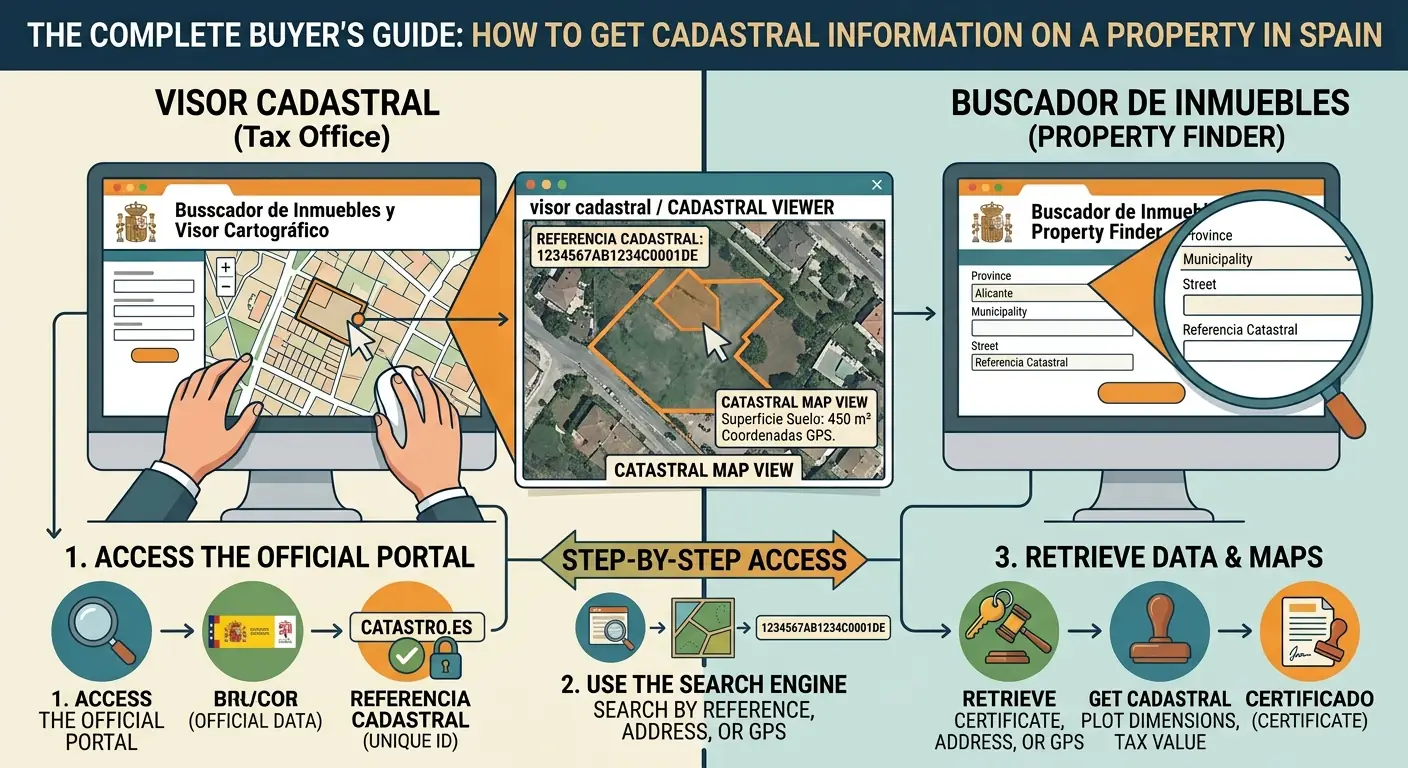
The Catastro is one of the first places to check when researching any property in Spain, and it's free to search. Here's what it is, how to find a property in it, and exactly what you can learn from it.
What Is the Catastro?
The Catastro is Spain's national property register for physical and administrative characteristics. It records a property's location, size, boundaries, year of construction, official use, and cadastral mapping.
The Catastro is not the same thing as the Registro de la Propiedad (Land Registry). The Catastro describes the property; the Registro records who legally owns it and what rights or charges are registered against it. They're two separate systems that answer two separate questions — see Catastro vs Registro de la Propiedad for the full comparison.
Referencia Catastral: Where Everything Starts
The referencia catastral is the unique reference number assigned to every property in the Catastro. It's the key that unlocks all the cadastral information available for that property.
You can usually find it in:
- the sale listing (not always shown, but the seller or agent can normally provide it);
- the Escritura or Nota Simple for the property;
- the IBI (property tax) receipt;
- a search by address on the Catastro's own portal, if you don't have it yet.
How to Search the Catastro Online
The official portal is the Sede Electrónica del Catastro. Its cadastral consultation section lets you find a property three ways:
- By referencia catastral — the most precise method, if you already have the number.
- By address — street, number, town, province.
- By cadastral map — a visual search, useful for houses with land where the exact address isn't obvious.
Once you've located the property, a cadastral certificate with its main characteristics becomes available.
What Cadastral Data Actually Tells You
Depending on the property type and the level of access, you can typically obtain:
- the referencia catastral;
- the exact built area (superficie construida);
- the year of construction;
- the property's official use (residential, garage, storage, etc.);
- the number of floors and the building's structure;
- the plot's area and boundaries, for houses with land;
- cadastral mapping of the property and neighbouring plots.
If the year of construction is what you're specifically after, How to Find a Property's Year of Construction in Spain covers that in more detail — including why the cadastral date isn't always the full story.
Public Data vs a Full Cadastral Certificate
Basic characteristics are available to the public through the portal at no cost. Fuller information — including anything tied to the owner — requires a legítimo interés (legitimate interest): a justified reason specific to that person, such as being party to an upcoming transaction. Where that applies, the Catastro's own portal sets out how to request and confirm that interest.
If you're unsure which type of certificate you need — a preliminary check before making an offer, versus the formal documentation for closing — it's worth confirming with the lawyer handling the transaction, or directly with the Catastro.
Why You Should Cross-Check Cadastral Data Against Reality
Once you have the cadastral information, compare it against:
- what the seller has told you;
- the property's Nota Simple;
- what you actually see when you visit the property.
A mismatch — in floor area, or in structures that exist on the plot but not on the cadastral map — doesn't automatically mean there's a problem. But an unexplained mismatch is exactly the kind of thing worth investigating further before you commit to buying.
Frequently Asked Questions
Is Catastro data free to check?
Basic characteristics — location, size, year of construction, cadastral mapping — are available for free through the Sede Electrónica del Catastro. Fuller information tied to the owner requires demonstrating a legitimate interest in the property.
Does the Catastro show who owns a property?
Not reliably, and not for legal purposes. Ownership is the job of the Registro de la Propiedad, checked via a Nota Simple — see What Does a Nota Simple Actually Show?
What if I don't have the referencia catastral yet?
You can still search the Catastro portal by address or by browsing the cadastral map, though a direct reference number search is the most precise method once you have one.
This article is part of our complete guide, How to Check a Property Before Buying in Spain.