The year of construction is one of the first facts worth establishing about a property. It shapes a lot of what comes next — from the condition you should expect from the electrics and plumbing, to which hidden problems are worth watching for.
Where to Find the Year of Construction
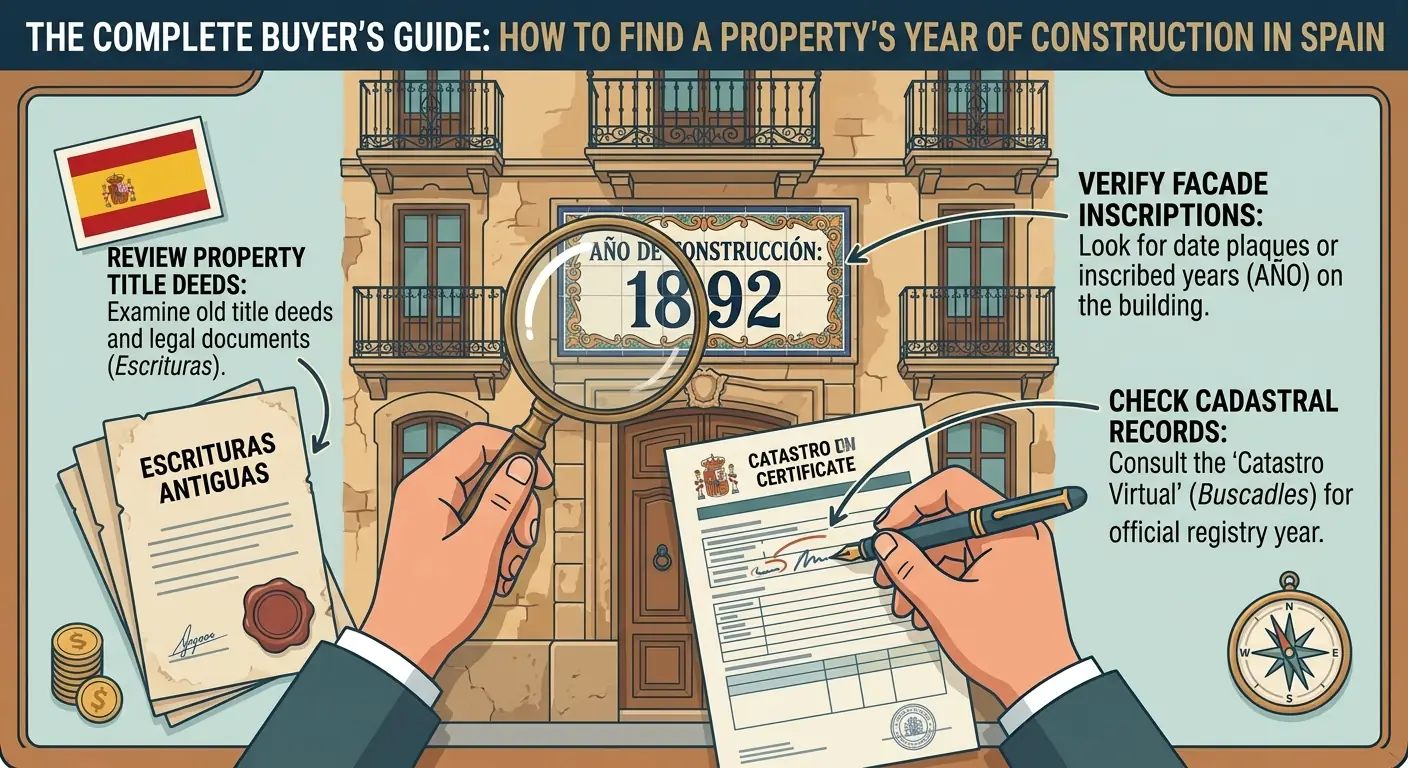
The main source is the Catastro. Through the Sede Electrónica del Catastro, you can find a property by address or referencia catastral and pull a cadastral certificate, which usually shows the year of construction (año de construcción).
📌 If you haven't looked the property up in the Catastro yet, start with How to Get Cadastral Information on a Property in Spain.
The year of construction can also sometimes appear in:
- the Nota Simple (not always, and not in every case);
- the Escritura from a previous sale;
- the Certificado de Eficiencia Energética;
- municipal (Ayuntamiento) records, if there were building permits on file.
Why the Cadastral Date Isn't the Full Answer
The year shown in the Catastro usually refers to when the property (or its main structure) was first registered. That doesn't mean everything you see today dates from that same year.
A typical scenario: a house is built in 1980, and later — without a separate registration, or with a delay — the following are added:
- a swimming pool;
- an extension or additional room;
- an enclosed terrace;
- a converted garage;
- an extra floor.
In that case, the cadastral date only reflects the year of the original construction. Later additions may not be reflected at all, may be partially reflected, or may only show up years after they actually appeared.
How to Check Whether the Property Matches the Cadastral Data
A useful practical step is to compare:
- the cadastral map and floor area available through the Catastro;
- the actual layout and floor area you see when visiting the property;
- historical cadastral mapping, where available — in some cases you can see how the plot's construction changed over time.
If the actual floor area is noticeably larger than the cadastral figure, or there are structures on the plot that don't appear on the cadastral map, that's worth investigating — when and on what basis they were added.
📌 If the discrepancy involves a specific extension, see our dedicated guide to checking whether an extension is legally authorised, coming soon in this series.
Year of Construction and Technical Condition Are Different Things
A building's age is a useful reference point, but it's not a diagnosis. An older house can be in excellent condition after a full renovation, while a relatively new one can have problems from poor construction quality or a lack of maintenance.
Use the year of construction as context for further checks — for example, paying closer attention to the wiring and ventilation in an older building — not as the only measure of a property's condition.
Frequently Asked Questions
Does the Catastro always show the correct year of construction?
It shows when the property, or its main structure, was first registered — which is a reliable starting point, but not proof that everything currently on the property (a pool, an extension, a converted garage) was built or registered at the same time.
If a property has a pool or extension, will the Catastro show when they were added?
Not necessarily. Later additions are sometimes reflected in the cadastral data, sometimes only partially, and sometimes not at all — especially if they were never formally registered.
Is an older year of construction a red flag?
Not by itself. Age is a useful prompt for closer attention to specific systems (wiring, ventilation, waterproofing) — it isn't, on its own, evidence of a problem.
This article is part of our complete guide, How to Check a Property Before Buying in Spain.