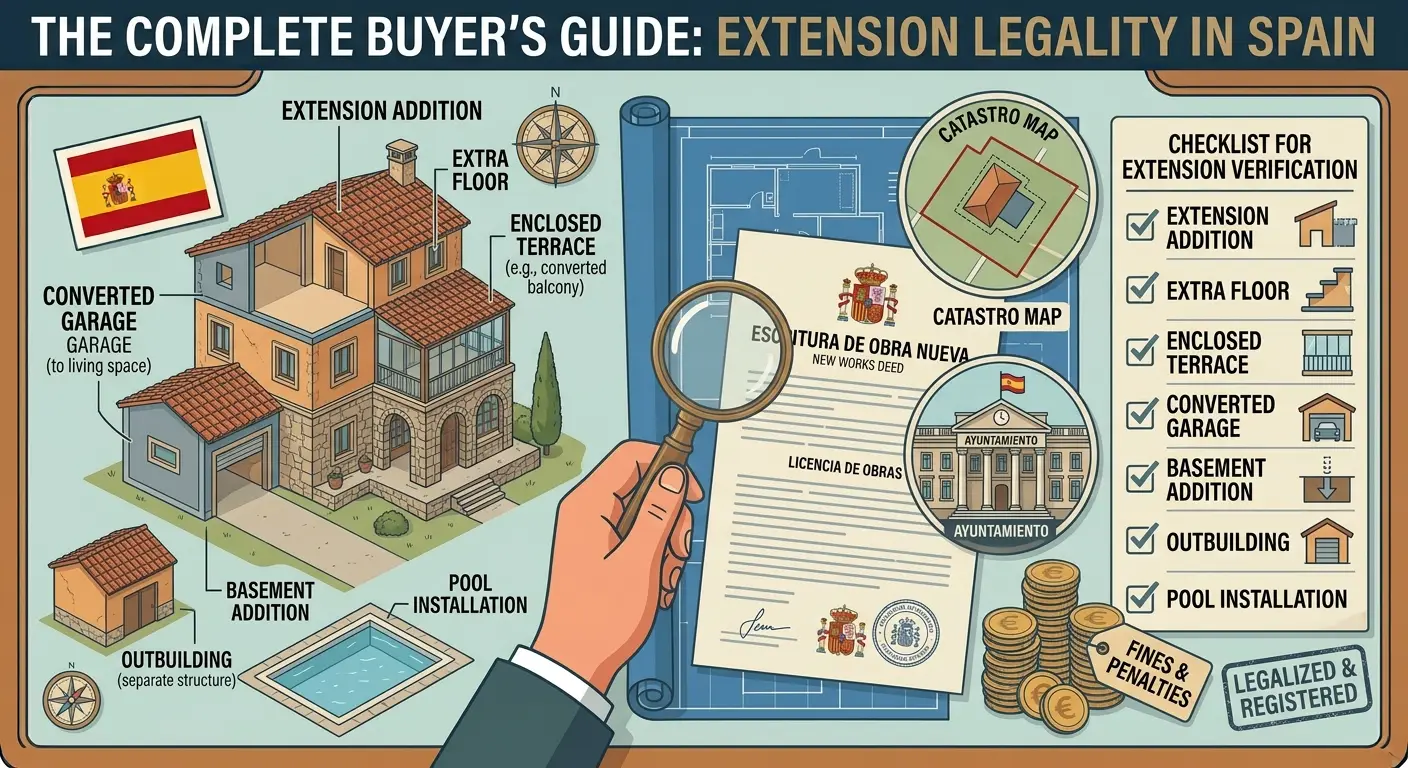
Extensions, extra floors, enclosed terraces, converted garages and basements are one of the most common sources of disputes and unpleasant surprises when buying a house in Spain. The problem is that visually these elements look completely normal — only checking the documentation shows whether they're actually legal.
Why This Can Be a Problem
An owner may have added a structure at some point without a building licence (licencia de obra), or built something that deviates from what was originally approved. Over time, these additions:
- may not be correctly reflected in the Catastro and the Registro;
- may have no matching municipal documentation;
- may, in some cases, fall under requirements to bring the work into compliance, or face other consequences under local planning law (urbanismo).
For a buyer, this means that along with the house, you can unknowingly acquire legal uncertainty over part of the property.
Which Elements Are Worth Checking First
- extensions to the main building;
- an additional floor or converted attic;
- enclosed terraces and porches;
- a converted garage (for example, turned into living space);
- a basement, if it's used as living or commercial space;
- freestanding structures on the plot (summer kitchen, storage building, guest house);
- a swimming pool, if it was added after the main house was built.
📌 If the property has a pool, we cover that separately in How to Check a Swimming Pool Before Buying a Property in Spain.
Step 1: Cross-Check Your Documents Against Each Other
Before contacting the town hall, it's worth comparing what you already have on hand:
- the floor area and description in the Catastro;
- the floor area and description in the Nota Simple (Registro);
- the description in the Escritura from the previous sale;
- the actual layout and floor area you see when visiting the property.
If every source shows the same floor area, but what you see on site is noticeably larger, that's a clear signal to investigate where the difference comes from.
📌 For how to get and read this data, see How to Get Cadastral Information on a Property in Spain and Catastro vs Registro de la Propiedad.
Step 2: Contact the Ayuntamiento
The definitive answer on a specific structure's status comes from the Ayuntamiento (town hall) covering the property — that's where the urbanística documentation is held: building licences (licencia de obra), first-occupation licences (licencia de primera ocupación), and the applicable planning documents (planeamiento urbanístico) for the plot.
It's worth understanding that the procedure and the amount of information available differ from one municipality to the next. What you can find out in one town through a simple request may need a more formal procedure in another. There's no single national "one-stop window" for this — you need to approach the specific Ayuntamiento involved.
As a rule, you can find out:
- whether a building licence was issued for a specific element;
- whether the structure complies with the plot's current planning regulations;
- whether there are open administrative proceedings (expedientes) for violations on the property.
If the Extension Turns Out to Be Unauthorised
Not every unregistered structure means you should walk away from the purchase. Depending on the situation and local regulations, several outcomes are possible — from the option to legalise it after the fact to more serious restrictions.
Legalization costs vary sharply by region and case, so treat any figure as a starting point rather than a rule: as one example, Aragón's own published guidance puts typical legalization costs at €350–3,000, excluding VAT and municipal fees, while a general project-and-certificate cost elsewhere commonly runs €300–1,500.
This is a case where it's worth:
- getting a written explanation of the situation from the Ayuntamiento, or through a lawyer specialising in urbanismo;
- assessing how it could affect the price, the terms of the transaction, or how you can use the property going forward;
- reflecting this information in the purchase contract, if needed.
Does an Old, Unlicensed Extension Ever Become Legal on Its Own?
Not exactly, but it's a common enough question to address directly. Urban-planning infractions in Spain generally become time-barred (prescriben) around 4 years after the work is finished — though the exact period ranges from roughly 1 to 6 years depending on the infraction's severity and the region (Catalonia allows 6 years, for instance, and Andalucía extended its own limit to 6 years for serious and very serious infractions).
Once that period passes, the structure typically moves into a legal status called fuera de ordenación ("outside planning order") — but this is not the same as the structure being legalised, and it doesn't remove every restriction on how the property can be used, renovated, or extended further. It's worth confirming the applicable limitation period for the specific region with a local lawyer rather than assuming a general rule applies.
A Practical Rule of Thumb
If the house is relatively simple, without obvious signs of additional structures, and all the documents match, a dedicated urbanismo check may not be necessary. But for an older house, a villa with land, or a property with visible signs of additions, this check is worth the time before signing — not after.
Frequently Asked Questions
Does a structure being unlicensed automatically mean I shouldn't buy the property?
No. Depending on the region and the specific situation, an unlicensed structure can sometimes be legalised after the fact — commonly for a project and certificate fee somewhere in the region of €300–3,000, though costs vary sharply by region and case — while in other cases it may face more serious restrictions. Getting a clear answer from the Ayuntamiento or a specialist lawyer before you commit is what matters.
Where do I go to check if an extension has a building licence?
The Ayuntamiento covering the property's location. Procedures vary between municipalities, so it's worth confirming in advance what's actually required for your specific case.
Does the Catastro show whether an extension is legally authorised?
Not reliably. The Catastro records physical characteristics, not legal or planning status — see Catastro vs Registro de la Propiedad for the distinction.
What if I only find out about an unauthorised extension after buying?
That's exactly why this check is worth doing before signing — sorting out the legal status of a structure after completion is a far more difficult and expensive position to be in, and by then you no longer have the option of pricing the risk into the negotiation.
This article is part of our complete guide, How to Check a Property Before Buying in Spain.