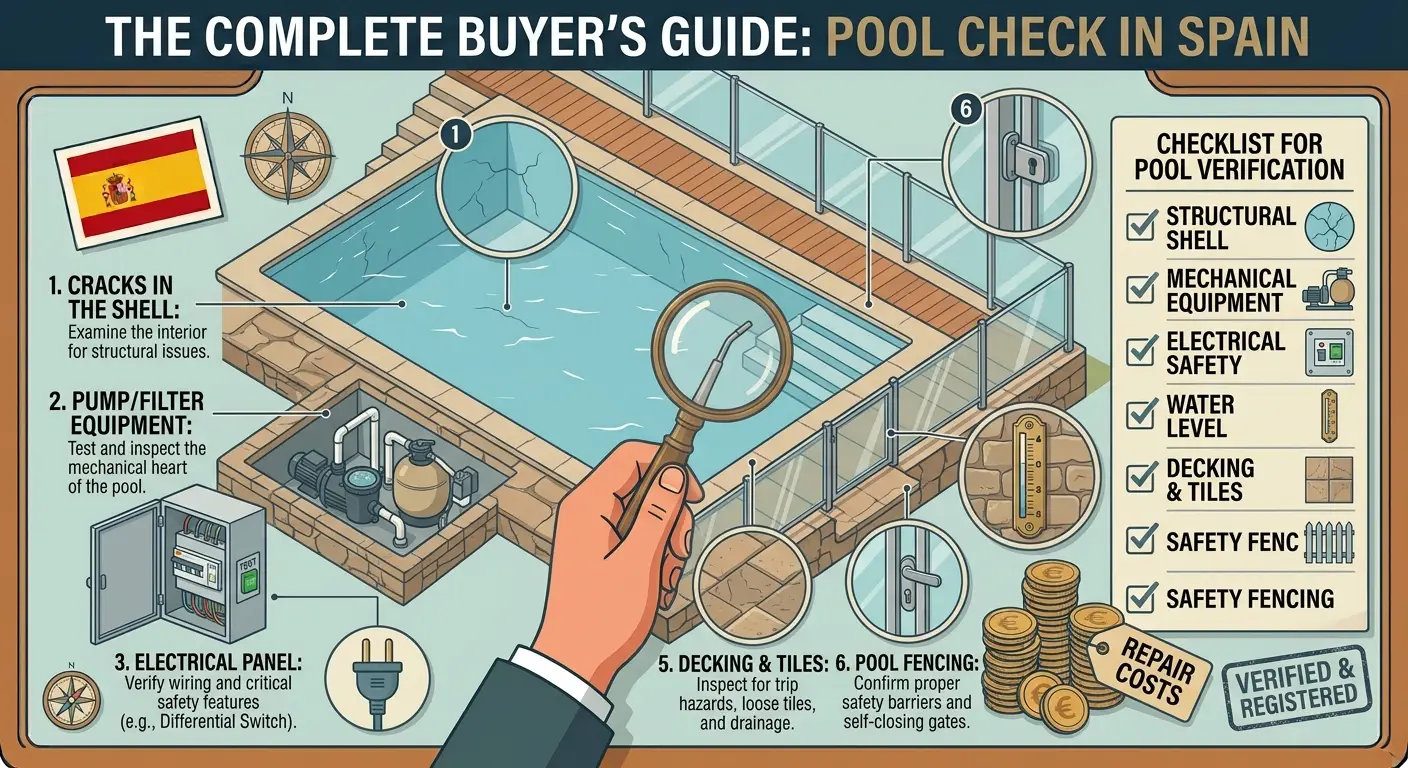
A pool is a welcome addition to a home — but it's also a source of two distinct kinds of risk: legal (whether it was legally authorised) and technical (the condition of its equipment and structure). Both are worth checking separately.
The Legal Side: Was the Pool Legally Authorised?
A pool is a structural element that, in many cases, requires its own municipal licence. If the pool was added after the house itself was built, it's worth finding out:
- whether it's reflected in the Catastro (the plot's cadastral mapping);
- whether it has a building licence (licencia) issued by the Ayuntamiento;
- whether it complies with the plot's current planning regulations.
Costs and consequences vary by region, so treat any figure as a starting point rather than a rule: legalizing an unlicensed pool commonly falls in a similar range to other unlicensed structures — roughly €350–3,000 depending on the region and case — and building one without a licence in the first place can draw a fine typically in the region of €500–3,000, depending on the municipality.
The house's year of construction in the cadastral data tells you nothing about when the pool was added — it's often a later, and not always separately registered, addition.
📌 The general approach to checking this kind of structure is covered in How to Check Whether an Extension Is Legally Authorised in Spain, and where to get cadastral data in How to Get Cadastral Information on a Property in Spain.
The Technical Side: What to Look For on a Viewing
Even a fully legal pool isn't necessarily in good working condition. A few areas are worth paying attention to.
The Pool Shell
- cracks, especially at the joints between the floor and walls;
- lifting or damaged finish (tiles, waterproof lining);
- signs of leaks — damp or ground subsidence near the shell;
- the water level and how quickly it drops (this can indicate a leak).
Pump and Filtration Equipment
- the pump's condition — noise during operation, signs of leaks, the equipment's age;
- the filter's condition (sand or cartridge) and when the media or cartridge was last changed;
- how well the filtration system is actually working — water clarity on the day of the viewing.
Electrical Safety
Electrical equipment near water is an area of elevated risk. It's worth confirming:
- whether there's dedicated residual-current (differential) protection for the pool circuit — Spain's low-voltage electrical code (the REBT's ITC-BT-31) specifically requires a maximum 30mA rating for circuits serving a pool, precisely because of this elevated risk;
- the condition of the visible wiring running to the pump and lighting;
- any signs of corrosion on electrical connections near the water.
📌 General principles for checking a house's electrical system are covered in the engineering-systems section of How to Check a Property Before Buying in Spain.
Water Treatment System
Chlorine, salt or another system — it's worth finding out which one is used, and the condition of the corresponding dosing equipment.
The Surrounding Area
- the condition of the tiles/decking around the pool (slipperiness, cracks, subsidence);
- drainage around the shell — where overflow and rainwater actually go;
- pool fencing, if required under local safety regulations.
Timing Matters
Viewing a pool out of season (in winter, when it's "winterised" and not filled) tells you less about how the system actually performs than a summer viewing does. If you're buying outside the season, it's reasonable to separately ask the seller to run the equipment during the viewing, or request video of the system running while the pool is filled.
Pool Maintenance Costs
It's worth confirming with the seller in advance:
- how often the pool is serviced, and what that typically costs (chemicals, cleaning, equipment servicing);
- the season it's used and the associated electricity costs (particularly if it's heated);
- whether insurance covers the pool separately.
As a benchmark, a standard outdoor pool typically costs in the region of €500–2,000 a year to maintain overall — commonly around €200–450 a year in electricity for the pump, €200–500 a year in chemicals, and roughly €40–50 a year to top up evaporated water.
When You Need a Specialist
A visual inspection covers the basics, but it can't always assess a hidden leak in the shell or the real condition of the pool's underground pipework. If there's a suspected water loss that isn't explained by evaporation, it's worth bringing in a pool specialist for more precise diagnostics — which can include pressure tests on the shell and a check of the underground lines.
Frequently Asked Questions
Does the house's year of construction tell me when the pool was built?
No. The cadastral year of construction usually refers to the main building. A pool is often added later and isn't always reflected in the cadastral data at all — see How to Find a Property's Year of Construction in Spain for more on this.
Is a pool always legal if it's been there for years?
Not necessarily. Age alone doesn't confirm legal status — that requires checking with the Ayuntamiento, the same way as for any other structure added after the main build.
What's the biggest electrical risk with a pool?
Missing or inadequate residual-current protection on the pool's electrical circuit. Spanish regulations require a maximum 30mA rating for this specifically because of the elevated risk of working with electrical equipment near water.
How do I know if a pool is losing water from a leak rather than evaporation?
Track the water level over a few still days without topping it up. A drop that's clearly faster than normal evaporation for your climate is worth investigating with a specialist, since a visual inspection alone can't confirm a shell or pipework leak.
This article is part of our complete guide, How to Check a Property Before Buying in Spain.