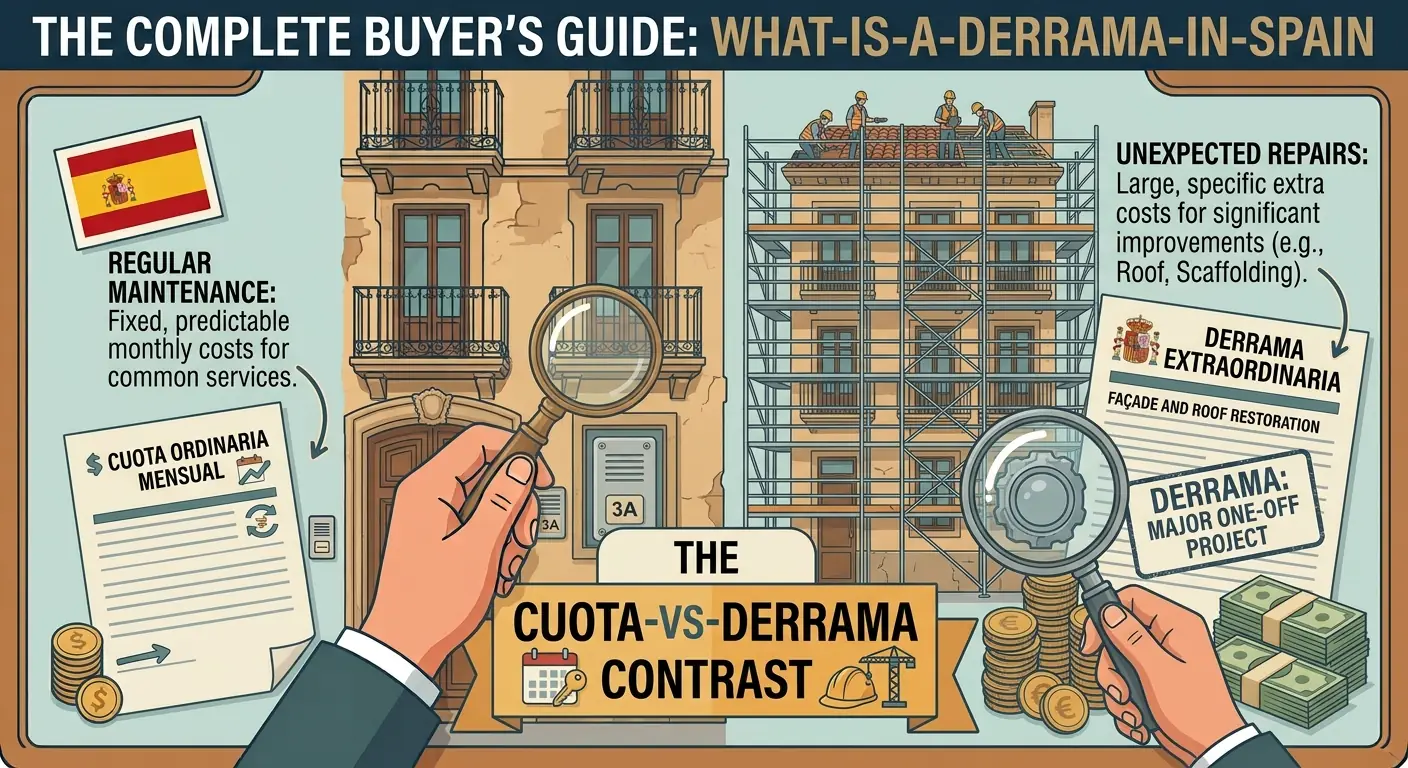
If you're buying an apartment in Spain, sooner or later you'll run into the word derrama. It's one of those topics where asking "how much" isn't enough — you need to understand what's actually behind the number.
Derrama in Plain Terms
Cuota is the regular, usually monthly, payment every owner makes to the Comunidad de Propietarios for the building's day-to-day upkeep: cleaning, lighting in shared areas, lift maintenance, insurance, and so on.
How much that actually runs to varies a lot by building, but as a ballpark: 2026 real-estate industry figures put the typical ordinary cuota for a Spanish apartment at roughly €100–110 a month, and buildings with a lift, pool, or concierge often land at €200–300. Spain's national statistics office, the INE, recorded a lower average — €881.28 a year per household — in its 2023 Encuesta de Presupuestos Familiares (Household Budget Survey), the most recent official figure available. Either number is only a starting point; the cuota for a specific building can sit well outside both.
Derrama is a separate, one-off charge (sometimes spread across a few payments) for a specific major job that the regular cuota doesn't cover. For example:
- repairing or replacing the roof;
- repairing the façade;
- replacing the lift;
- repairing shared utilities (plumbing, drainage, wiring);
- repairing the pool or garage, if they're part of the shared property;
- the Comunidad's legal costs, if the assembly has voted for them.
Put simply: the cuota is for "keeping the lights on." A derrama is for "this one big project."
Unlike the cuota, there's no single reliable national average for a derrama — the amount depends entirely on the scope of the job and the building's size, so it's worth treating any figure as illustrative rather than a rule of thumb. As a sense of scale, façade rehabilitation work typically costs in the region of €30–120 per square metre depending on materials and the type of intervention, according to renovation-cost data from Habitissimo; a well-documented Madrid case involved a €420,000 ventilated-façade project, working out to roughly €7,500 per owner. A modest lift installation (four stops) commonly adds at least €15,000 on top, again split across owners by their coeficiente de participación. Roof and structural work vary even more widely depending on the building's condition and size.
Who Pays a Derrama — the Seller or the Buyer?
This is the first thing to establish if a derrama has already been approved, or is under discussion.
The general rule: liability for a derrama is normally tied to whoever owns the property at the point the assembly approves the work and the payment falls due — unless the parties agree otherwise in the sale contract. In practice, buyers and sellers often agree something different — for example, that the seller covers payments already invoiced, while the buyer takes on future ones.
This is significant enough that it should be written into the contract explicitly, not left to default assumptions — otherwise a dispute over who owes the next instalment can surface after the deal has already closed.
This is general information, not legal advice — the exact split for a specific property should be agreed with the lawyer handling the transaction.
📌 For how to check the Comunidad's overall financial situation before buying, see How to Check for Comunidad Debts in Spain
What to Ask Before You Buy
Knowing the total isn't enough. Worth finding out:
- What exactly is being repaired or replaced — the actual scope of work.
- Has the assembly actually approved it — is there a signed acta from the Junta de Propietarios, or is it still just under discussion?
- What's the total project cost, and what share falls on this specific apartment — usually calculated via the coeficiente de participación.
- The payment schedule — a single lump sum or several instalments, and when the next one falls due.
- What's already been paid — how much of this derrama the seller has already covered, and what's left.
- Whether there's more coming — sometimes what looks like a single derrama is really just the first of several planned ones.
The source for all of this is the actas of the Juntas de Propietarios from the last few years, plus a certificate from the Comunidad's administrator (administrador de fincas).
Why This Matters More in Older Buildings
A freshly renovated apartment can sit inside a building that's months away from an expensive façade repair, roof job, or lift replacement. The interior finish of the unit says nothing about the condition of the building's structural elements — they're two separate stories.
That's exactly why, for apartments in older buildings, it's worth checking not just current derramas but the building's general technical condition — roof, façade, shared systems.
And "older buildings" describes a large share of the Spanish market, not a niche case. Spain's housing stock runs to 26.6 million dwellings, with an average age of 43.5 years, and nearly 30% are over 70 years old, according to the INE's 2021 Population and Housing Census (Censo de Población y Viviendas). A building that age has usually already been through — or is overdue for — at least one major derrama, which is exactly why checking recent actas matters as much as the apartment's own condition.
Derrama vs. IBI — Don't Mix Them Up
A derrama belongs to the Comunidad de Propietarios and has nothing to do with IBI (Impuesto sobre Bienes Inmuebles), the municipal property tax. These are two independent payments of a completely different nature: one is a decision made by the building's owners, the other is a state tax.
Frequently Asked Questions
Is a derrama the same as the monthly Comunidad fee?
No. The cuota is the regular recurring payment for day-to-day upkeep. A derrama is a separate, one-off charge for a specific major project — a new roof, a façade repair, a lift replacement — that the cuota doesn't cover.
Who pays a derrama when an apartment is sold — the buyer or the seller?
By default, whoever owns the property when the assembly approves the work and the payment falls due — but this is frequently negotiated differently and should be written explicitly into the sale contract rather than assumed.
How do I find out if a derrama is coming before I buy?
Ask for the minutes (actas) of the last few Juntas de Propietarios and a certificate from the building's administrator — these show approved and discussed derramas, not just what the seller happens to mention.
Can a derrama I didn't know about become my problem after I buy?
Only if you didn't check for it. This is exactly why reviewing recent actas before signing matters — a derrama already approved but not yet invoiced can otherwise catch a new owner by surprise.
This article is part of our complete guide, How to Check a Property Before Buying in Spain.