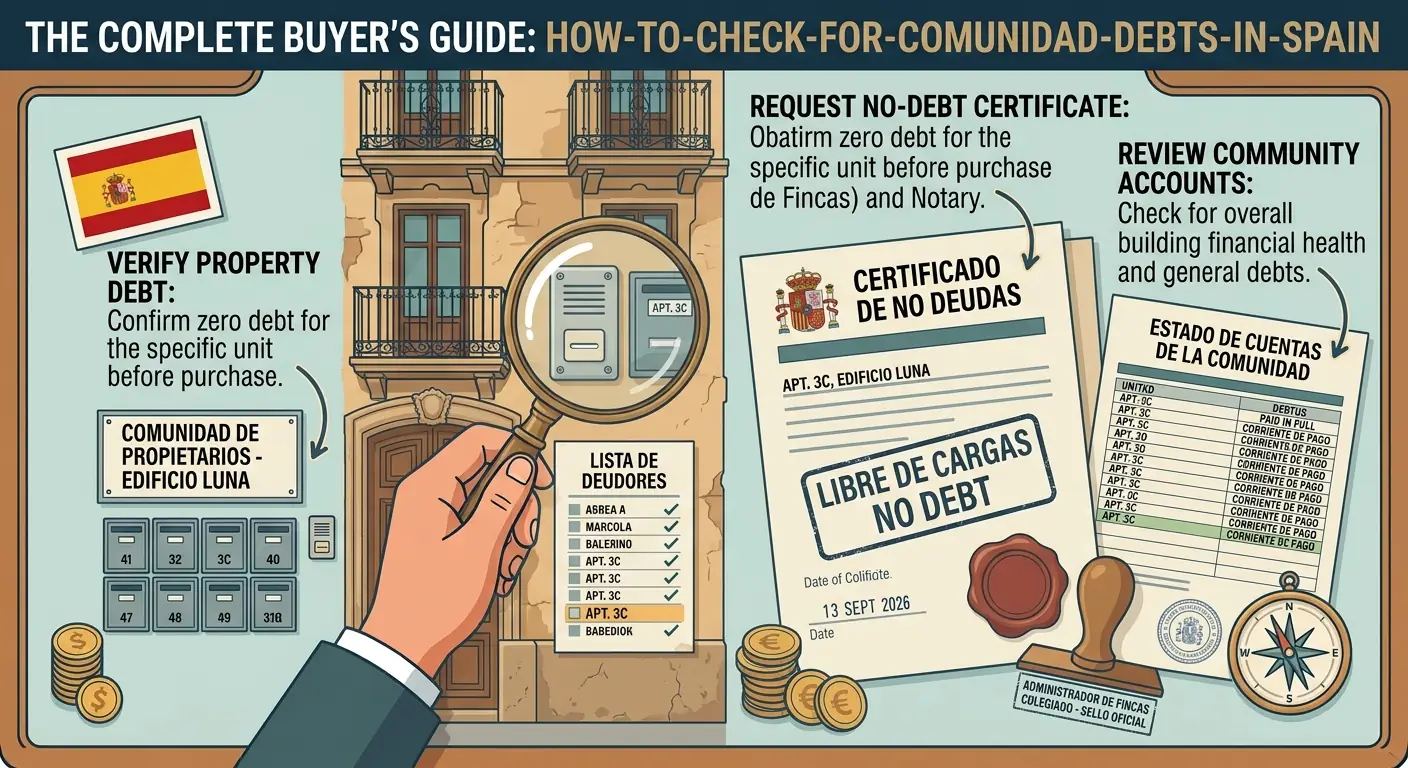
Buying an apartment means acquiring not just the unit itself, but a share of the building's shared property — and with it, potential liability for part of the Comunidad de Propietarios' financial history. Checking for debt isn't a formality; it's one of the key items in your due diligence.
Why a Previous Owner's Debt Can Become Your Problem
Spanish law (the Ley de Propiedad Horizontal) makes an incoming owner liable to the Comunidad for the previous owner's unpaid debt, up to the amount covering the current calendar year and the three preceding ones.
In plain terms: if the seller had unpaid cuota or derrama charges from recent years, part of that debt can transfer along with the apartment to the new owner — unless the parties have specifically resolved it beforehand.
This isn't a rare edge case. Spain has an estimated 1.4 million Comunidades de Propietarios (there's no single official registry, so this is an estimate based on national housing stock), and owners collectively owe them roughly €1.6 billion in unpaid fees, with at least one delinquent owner present in around 38% of Comunidades, according to the Consejo General de Colegios de Administradores de Fincas de España (CGCAFE).
This is general information, not legal advice. The exact wording and mechanics for a specific property should be agreed with the lawyer handling the transaction.
The Key Document: A Certificate of No Debt
When an apartment is sold, the seller is obliged to provide (or the buyer can request) a certificate from the Comunidad — usually issued by the secretary or administrator — confirming the state of the cuota account at the time of the transaction. This certificate either confirms there's no debt, or states the amount owed.
If that certificate isn't provided, the buyer (through a lawyer or notary) can waive the seller's obligation to supply it — but in that case, it's worth pricing in the risk separately, typically by factoring an equivalent amount into the price negotiation or the sale terms.
What to Request Before Signing
- A certificate of no debt (certificado de estar al corriente de pago) — the most direct way to check.
- The minutes of recent Juntas de Propietarios (actas) — these record not just debts, but also:
- approved and planned derramas;
- legal disputes involving the Comunidad (including against debtors);
- major upcoming expenses (roof, façade, lift repairs).
- The current cuota amount — so you understand the regular financial load after buying.
For reference, real-estate industry data from 2026 puts the average ordinary cuota for an apartment in Spain at around €100–110 a month (roughly €1,260 a year), while Spain's national statistics office, the INE, recorded average annual community-expense spending of €881.28 per household in its 2023 Encuesta de Presupuestos Familiares (Household Budget Survey) — the most recent official figure available. Either way, treat these as a rough benchmark: buildings with a lift, pool, or concierge commonly run to €200–300 a month, so the number for a specific property can vary well beyond the average.
📌 If a derrama comes up in the minutes, find out exactly what it covers — see What Is a Derrama When Buying an Apartment in Spain?
What to Look for in the Meeting Minutes
The actas de las Juntas de Propietarios are a source of information you won't see on a normal viewing:
- discussions of roof or façade leaks;
- decisions on major repairs;
- disputes between owners, or with the developer;
- chronic debtors among the owners (which can mean the Comunidad's budget is regularly short);
- ongoing legal proceedings involving the Comunidad.
If there's no way to get the minutes from the seller, a prospective buyer can sometimes request them directly from the building's administrator, explaining the purpose — though access procedures can vary from one Comunidad to another.
The Bottom-Line Checklist
- ☐ Requested a certificate of no debt with the Comunidad
- ☐ Obtained the minutes of the last 2–3 meetings
- ☐ Know the current cuota amount
- ☐ Checked whether there are approved or discussed derramas
- ☐ Discussed liability for any prior-period debt with a lawyer, and had it reflected in the contract
Frequently Asked Questions
Am I liable for the previous owner's Comunidad debt?
Potentially, yes — Spanish law makes the property (and so the incoming owner) liable for the seller's unpaid Comunidad charges covering the current year plus the three preceding calendar years, unless the sale terms address it separately.
What's the single most useful document to request?
The certificado de estar al corriente de pago — a certificate from the Comunidad confirming whether the seller's account is up to date, and if not, by how much.
Do the meeting minutes really matter if the debt certificate is clean?
Yes. A clean certificate only covers debt as of that date — it won't show you an already-approved derrama that hasn't been invoiced yet, ongoing legal disputes, or a pattern of chronic non-payment by other owners that signals a structurally underfunded Comunidad.
What if the seller can't or won't provide the certificate?
A buyer can waive that requirement through their lawyer or notary, but doing so blind carries real risk — it's generally safer to either insist on the certificate or price the uncertainty into the negotiation.
This article is part of our complete guide, How to Check a Property Before Buying in Spain.