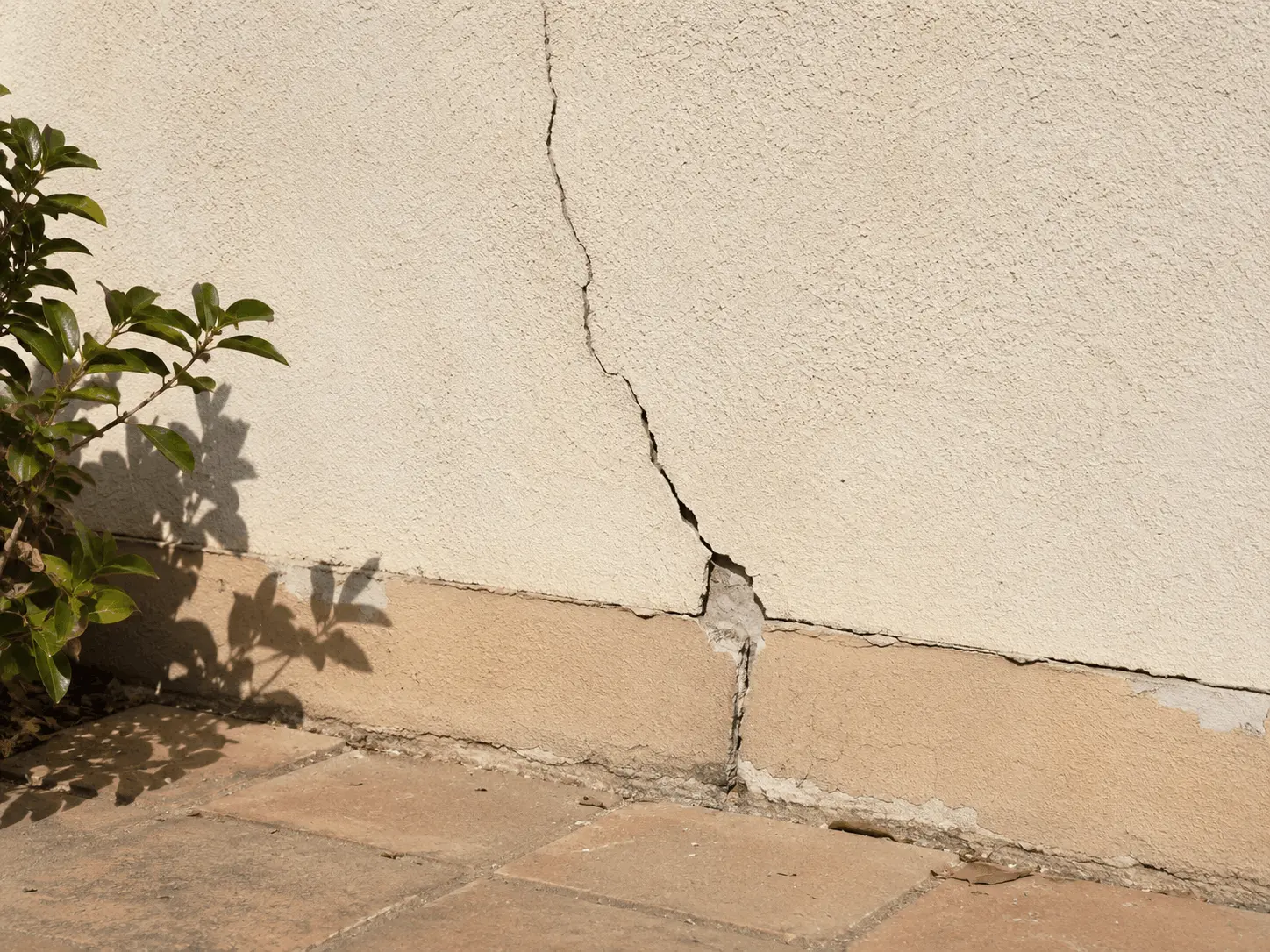
This inspection covers a detached villa in El Campello where a diagonal crack roughly 40cm long was found on the north foundation wall. A door in the adjacent room no longer closes flush with its frame, and the surrounding garden slopes toward the house rather than away from it. A tape test placed across the crack a week before this report showed no further movement in that period. This villa foundation crack case in El Campello illustrates how settlement-related damage typically presents before a fuller geotechnical picture is available.
Field Observations
The crack runs diagonally across the north foundation wall for approximately 40cm, widening slightly toward its upper end, a pattern consistent with differential settlement rather than shrinkage cracking.
In the room directly above this section of wall, the door binds against its frame on the latch side, and the gap at the head of the frame is visibly uneven. A tape gauge fitted across the widest point of the crack a week prior to this inspection showed no change in width, which suggests the movement, if ongoing, is currently slow.
The garden grade outside the affected wall slopes toward the building rather than falling away from it, a detail worth flagging independently of the crack itself.
What Inspectors Check For a Villa Foundation Crack in El Campello
- Crack orientation, width, and any stepping pattern in the masonry or render
- Door and window alignment in rooms above or adjacent to the affected wall
- Tape gauge or crack monitor readings taken over a period of weeks to months
- Ground grading and drainage falls around the foundation perimeter
- Signs of soil type at the surface (sandy, fill, or exposed bedrock)
Why It Happens
Much of the coastal plain around El Campello sits on alluvial and made ground, a mix of variable bearing capacity that settles unevenly once a structure loads it. A foundation crack like this one often traces back to one section of the footing bearing on firmer material than an adjacent section, so the wall settles at different rates along its length. Garden grading that slopes toward the house adds to the risk, since it directs rainwater against the foundation instead of away, and repeated wetting can wash out fines beneath the footing over time. Villas built without a documented geotechnical study, common on plots developed before the current building code required one, carry a higher chance of this kind of mismatch between the ground and the foundation design.
Why It Matters
A diagonal crack with door misalignment is one of the clearer field indicators of differential settlement, and the priority is establishing whether the movement is ongoing or has stabilised. A crack that has stopped moving is a repair and monitoring matter; one that continues to widen points toward an active ground issue that needs a geotechnical study before any cosmetic repair is worthwhile. Because settlement can affect load paths through the structure, this finding sits in a different category from surface cracking in render, and it is worth treating with more caution even when the initial readings look stable.
How Inspectors Evaluate It
Crack gauges or simple tape tests, fitted across the widest point and read over a period of three to six months, give the clearest picture of whether movement is active or historic. A laser level survey of the floor inside the affected rooms can confirm whether the slab itself has tilted, which corroborates or contradicts the door-alignment observation. Where the garden grading directs water toward the foundation, a follow-up inspection after heavy rain is useful to see whether pooling occurs at the wall base. If early monitoring shows continued movement, a trial pit or full geotechnical study becomes the next step, since visual inspection alone cannot confirm bearing capacity or soil composition below the footing.
Equipment Used
- Crack gauges or tell-tales for movement monitoring
- Laser level for floor-tilt survey
- Spirit level and gap measurement for door and window alignment
- Trial pit and soil sampling where a geotechnical study is warranted
Repair Options
- Continue crack monitoring for a further two to three months before any structural repair, if the tape test remains stable
- Regrade the garden so surface water falls away from the foundation rather than toward it
- Commission a geotechnical study if monitoring shows continued widening
- Resin or mechanical stitching repair for the crack itself, once movement has stabilised
- Micropile or resin injection underpinning if a geotechnical study confirms an active settlement issue
When Immediate Action Is Recommended
The current readings do not point to an emergency, since the tape test showed no movement over the monitoring period so far. That said, correcting the garden grading is worth doing promptly, since it removes one contributing factor regardless of what the longer monitoring period shows. If the crack begins to widen, if new cracks appear elsewhere on the same elevation, or if the door misalignment worsens, that combination would justify moving directly to a geotechnical study rather than continuing to monitor.
Maintenance Tips
- Keep a photographic or tape-gauge record of the crack at consistent intervals
- Correct any grading or drainage that directs water toward the foundation
- Re-check door and window alignment every few months for early signs of further movement
- Avoid planting large trees close to the affected elevation, since root activity can compound ground movement
- Keep the monitoring record available for any future survey or sale, since it documents whether the defect is active or historic
Summary
This villa foundation crack in El Campello shows the classic combination of a diagonal crack, door misalignment, and unfavourable garden grading, set against ground conditions typical of the Alicante coastal plain. A week of tape-test monitoring found no further movement, which is a reasonable starting point but not yet long enough to rule out slow, ongoing settlement. Correcting the drainage grade now and extending the monitoring period gives a clearer basis for deciding whether a geotechnical study and underpinning are needed, or whether a straightforward crack repair will hold.
Frequently Asked Questions
Does a 40cm crack always mean the foundation needs underpinning?
Not always. Underpinning becomes relevant when monitoring confirms ongoing movement and a geotechnical study identifies a specific bearing-capacity problem. Many cracks of this size stabilise and only need a straightforward repair once the movement has stopped.
How long should crack monitoring continue before deciding on repair?
Three to six months is a typical minimum, since seasonal ground moisture changes can influence movement readings. A single week, as recorded in this case, is a useful starting point but not sufficient on its own.
Why does garden grading matter for a foundation crack?
Grading that slopes toward the house directs rainwater against the foundation rather than away from it, which can wash out fine material beneath the footing over time and contribute to further settlement.
Is door misalignment a reliable sign of foundation movement?
It is a useful supporting indicator, particularly when it appears in a room directly above or adjacent to the crack, but it should be confirmed with crack monitoring and, if needed, a floor-level survey rather than treated as proof on its own.