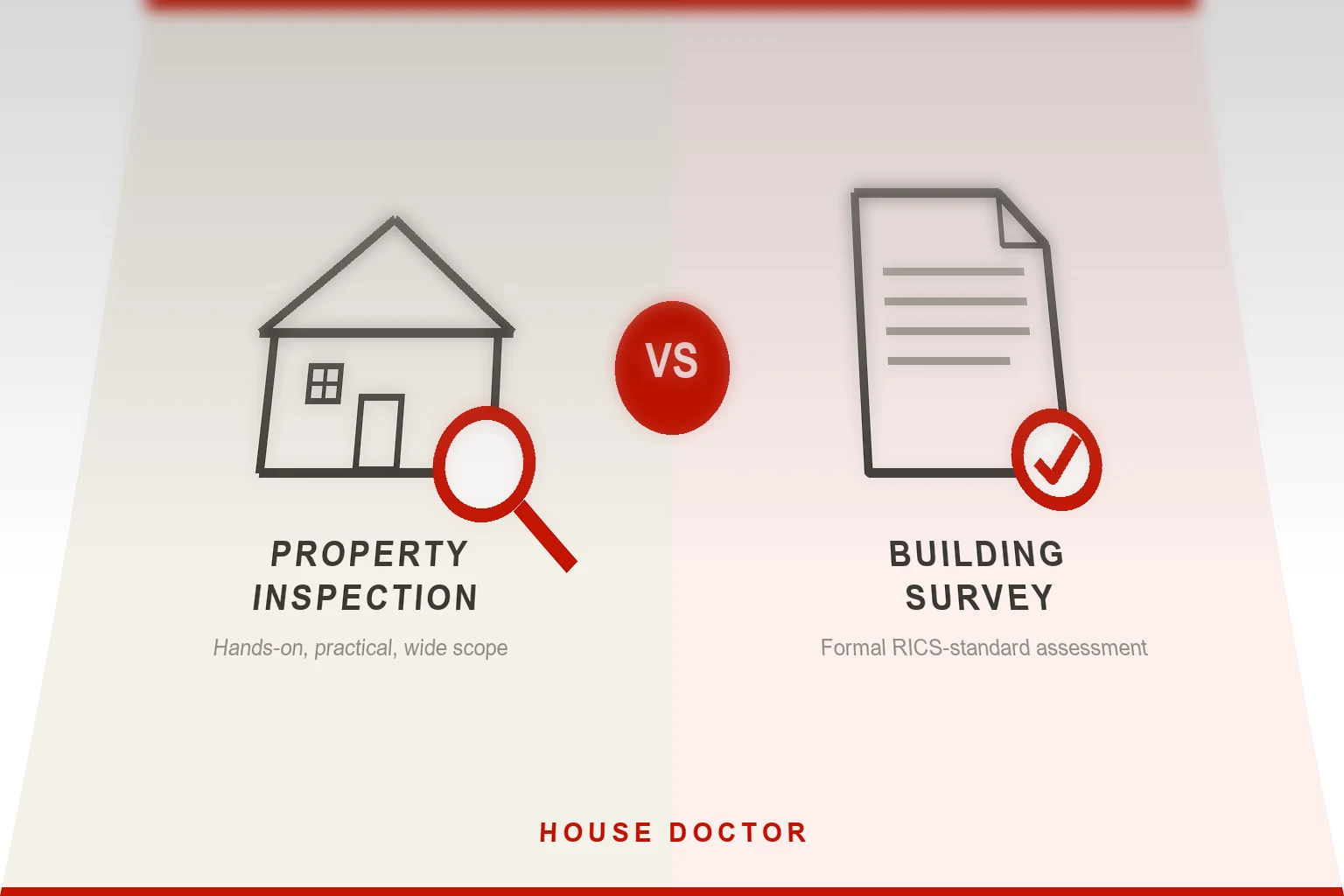
If you've started researching how to check a property before buying in Spain, you've probably run into four terms within the space of a few web pages: property inspection, property survey, building survey, and structural survey. Different agents use them differently. Different websites define them differently. And if you're used to the UK or Irish system, the vocabulary you already know doesn't map onto Spain in quite the way you'd expect.
The honest answer isn't that these terms are all the same thing wearing different labels. It's that they overlap, but they are not necessarily interchangeable — and understanding exactly where they overlap, and where they genuinely differ, is what actually helps you choose the right service instead of just the most familiar word.
Property inspection and building survey: overlapping, not identical
"Property inspection" is a broad umbrella term. Depending on the inspector and the scope agreed with the client, it can cover a wide range of checks: damp, heating, air-conditioning, electrics, plumbing, gas installations, swimming pool, visible defects, and accessible structural elements. Because the term isn't tied to one professional body or one fixed methodology, its exact scope varies from one inspector, company, or market to the next.
"Building Survey," in the British professional sense, means something more specific. It was historically the name of a defined RICS (Royal Institution of Chartered Surveyors) service, and today it corresponds to RICS Home Survey Level 3 — the most detailed of RICS's three standardised survey levels, with its own defined scope and inspection methodology (more on exactly what that includes below).
So it isn't accurate to say a property inspection and a building survey are simply the same service under two names. It's more accurate to say this: these terms overlap, but they are not necessarily interchangeable. A property inspection can give a genuinely practical, useful assessment of a property's condition without being a full RICS Building Survey — and it's worth being upfront about that difference rather than blurring it to sound more impressive.
RICS home survey levels: not one service, but three
Here's where the confusion usually gets worse rather than better. "Building survey" itself isn't one fixed thing either. RICS operates three standardised levels of home survey, each with a different depth of inspection and a different intended use: Level 1 (formerly the Condition Report), Level 2 (formerly the HomeBuyer Report), and Level 3 (formerly the Building Survey — the specific service most people actually mean when they say "building survey").
Every level uses the same condition-rating system to flag what's found: CR1 (green) — no repair currently needed, maintain as normal; CR2 (amber) — a defect exists and should be repaired or replaced, but it isn't urgent; CR3 (red) — a serious defect needing urgent repair, replacement, or further investigation, and a common trigger for renegotiating the price or reconsidering the purchase.
The three levels differ substantially in how far the inspection goes, not just in how long the report is:
| Level 1 | Level 2 | Level 3 | |
|---|---|---|---|
| Best suited to | Conventional modern homes, satisfactory condition | Conventional properties, reasonable condition, simple form, no major alterations | Large, older, altered/unusual, or run-down properties; before major works |
| Windows | At least one per elevation opened | One per elevation and one of each type opened | Attempts to open all |
| Roof space | Viewed via ladder (≤3m); no panels removed, no lifting insulation | Enters and visually inspects the structure | Enters, inspects, and lifts insulation corners to check thickness/type |
| Floors | Visual only, heel-drop test, no lifting coverings or furniture | Same as Level 1 | Visual, heel-drop, lifts loose carpet corners, enters under-floor void where safe |
| Drainage | Not inspected | Accessible chamber covers lifted, visually checked | Same, plus observes drains in normal operation |
| Services | Visual sample only, nothing tested | Visual only, no testing | Visual, operates a sample of lights/extractor fans, asks occupier to run heating — still not formally tested |
| Grounds | Cursory walk-around | Thorough inspection within the boundary | Comprehensive; follows the trail of a suspected problem further |
| Repair/maintenance advice | None | Some | Full, with priority/timescale and optional cost indications |
| Valuation / insurance figure | Not included | Optional add-on | Not included |
| Typical cost (UK, property £100k–£1m) | £300–£900 | £400–£1,000 | £630–£1,500+ |
One thing stays constant across all three levels: it's always a visual, non-invasive inspection. No level opens up walls, removes secured panels, or runs invasive tests or design calculations — not even Level 3. The step-up between levels is how far the visual inspection is pushed and how much interpretation the report gives, not a difference in fundamental access to the building.
Which level fits which property
Level 1 exists for straightforward cases: a conventional, modern home already believed to be in satisfactory condition, where the buyer mainly wants independent, written confirmation that nothing is hiding.
Level 2 suits the most common transaction: a conventional property in reasonable condition, simple in form and layout, without a history of significant alterations or extensions — a typical resale flat or a straightforward house.
Level 3 is built for everything more demanding: a large, older, altered or architecturally unusual property; anything already showing signs of poor condition; or any property — of any age — before major renovation work. That description covers a large share of the villas, fincas, and older townhouses that international buyers in Spain are actually looking at.
Structural survey: a different question again
A structural survey isn't a level of RICS home survey at all — it sits outside that ladder entirely. It's a separate, narrower, specialist investigation commissioned to answer one specific question about one specific concern: what's causing this crack, this movement, this sign of settlement, and what needs to be done about it. It's carried out by a structural engineer or specialist, is often narrower in scope than even a Level 1 property inspection, and can involve more invasive testing where necessary — opening up sections a standard survey would never touch.
A structural survey isn't usually where you start. It's where you go after a property inspection or building survey flags something specific that needs closer investigation — though if a serious structural concern is already obvious before you even arrange an inspection, there's no reason to wait; you can go straight to a specialist.
So what does a HouseDoctor property inspection actually cover?
Given all of the above, it's worth being precise about where HouseDoctor's own pre-purchase property inspection sits. It is a property inspection. It is not a RICS Level 3 Building Survey, and it is not a structural investigation — and it shouldn't be described as either, because that would overstate what it does and understate what it actually does well.
In some areas, a RICS Level 3 Building Survey genuinely goes deeper than a HouseDoctor inspection. Its structural elements are examined more exhaustively; the roof structure is entered and inspected with insulation lifted to check thickness and type; under-floor voids are entered where safe; and the whole exercise sits inside a single, formally recognised professional methodology with a standardised report format.
But in many other areas, a HouseDoctor inspection goes considerably further than a standard building survey does. A building survey — at any RICS level — inspects services visually and never tests them. A HouseDoctor inspection doesn't stop at looking: major appliances are operated and tested, not just glanced at; a thermal imaging camera is used to check insulation performance, radiator distribution and hidden damp patterns that aren't visible to the eye; moisture meters take actual readings rather than a visual impression; water pressure and flow are measured rather than assumed from a running tap; and — in a detail that regularly surprises buyers — the air-conditioning or heating system's installed capacity is assessed against the size of the space it's meant to serve, because a system that switches on and blows cold air can still be too small for the room, and that's not something a five-minute viewing, or a purely visual survey, would ever catch.
Put together, a HouseDoctor property inspection focuses less than a full building survey on exhaustively assessing structural integrity and hunting for structural defects across the whole building. But across almost every other dimension — the systems, installations, appliances, and measured performance of the property — it goes considerably deeper, and covers a broader set of property aspects and parameters than a structural-focused survey ever attempts to. Neither is "better" in the abstract. They're built to answer different questions.
Start with the question, not the label
Rather than asking "do I need a building survey," it's more useful to ask what specific question you actually need answered — because each question points to a different service:
"What condition is the house in, overall?" → a property inspection.
"Do I need a more detailed, formally recognised assessment of the building's structure and fabric?" → a building survey (RICS Level 3 or an equivalent local standard).
"What's causing this specific crack, or sign of movement?" → a structural investigation.
"Is this extension, pool, or terrace legally authorised?" → legal and planning due diligence, not a technical inspection at all.
"What's the property actually worth?" → a valuation — and if you're financing the purchase, note that your bank's own valuation (tasación) exists to protect the lender's security, not to protect you, so it's not a substitute for any of the above.
One more Spain-specific term is worth keeping separate from all of this: the ITE (Inspección Técnica de Edificios), a mandatory, periodic inspection of a building's common elements, ordered by the community of owners rather than an individual buyer. It tells you about the building as a whole on a legal compliance cycle — not about the specific unit you're buying, and not to the depth any buyer-commissioned inspection would.
For almost every purchase, starting with a property inspection remains the sensible move — not because it's a lesser version of a building survey, but because it's broad, practical, and genuinely useful at answering the first and most common question: what condition is this property actually in? If it flags something that needs a more formal building survey, or a specific structural concern, or a legal question about what's actually authorised, that's the signal to bring in the right specialist for that specific question — rather than guessing which expensive service to commission first.